Posts

Showing posts with the label RIVERS

The Pakhavaj Players of Alandi

Image
Introduction Alandi is well known as the residence and final resting place of Sant Dnyaneshwar - one of the most important figures of the Warkari sect and one of the principle saints of Maharashtra. The town is thus a major place of pilgrimage in the state. The town lies just to the north of Pune city, on the banks of the Indrayani river which it straddles with immense bathing ghats. Alandi - under lights I have been meaning to visit Alandi for a long time, but for one reason or the other, that never happened. Until this time. -x-x-x- An Accidental Visit On a midnight drive to a place further north from Pune, we passed through the town of Alandi. While crossing the bridge over the Indrayani we were caught by the sight of the sprawling and empty ghats and decided to halt for a while. The illuminated ghats of Alandi -x-x-x- The Sounds Under Lights The visual delight of the ghats under lights quickly transformed to a more musical one with each step we took - for...

Under The Sands Of Talakadu

Image
Introduction The town of Talakadu, located about 45km from Mysuru, is a curious place. It is located on the left (northern) bank of the Kaveri, surrounded by high mounds of sand. Under these sands, it is believed, lie the remains of over thirty temples that were a site of active worship and pilgrimage up to the 17th century. What had followed then can be best summarized as an ecological disaster. Or as the locals would have it - a curse. The sands of Talakadu A few of these temples have been unearthed (or, unsanded?). -x-x-x-   The Curse Of Talakadu The curse of Talakadu inflicted by Queen Alamelamma of Srirangapatanam on the Wodeyars of Mysore has three aspects which are translated as: "May Talakadu be filled with sand; Malangi (on the other bank) be a whirlpool, Mysore Kings shall not have offsprings". The first and the last aspect have held true over a course of three centuries. While one is unsure about the genetics of the Wodeyar Family, the first aspec...

The Exquisite Vijayanagara Temples Of Tadipatri

Image
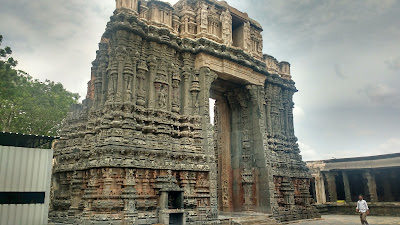
Introduction The Vijayanagara Empire flourished at Hampi and the legacy has made it a major site for the Vijayanagara school of architecture. However, in terms of the striking intricacy of the sculptures, Hampi may have been beaten by the temples at Tadipatri some 200km away. The temples here are almost contemporary to those at Hampi, but built by their Pemmasani Naidu feudatories. The majestic gopuram of the Bugga Ramlingeshwara Temple -x-x-x- Tadipatri Impressions The town of Tadipatri is located on the southern bank of the Pennar river. The river here mostly resembles a dry, uneven depression throughout the year owing to a dam upstream. The area around Tadipatri is marked with dark depressions left behind by the quarries of Kadapa stone (black limestone). An amusing side-effect of the stone mines is that most of the shanties here are actually made of discarded slabs of these stones. The town itself is quite busy and is a centre of industrial a...

The Pennar Gorge & Gandikota Fort

Image
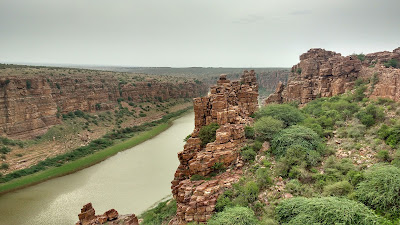
Introduction Tucked away in the remoteness of the Telugu-hinterland, lies a sight that has the potential to humble man before the glory and raw power of the natural order. The river Pennar (also Penna, Penneru), originating near the Nandi Hills in Karnataka, winds its way first north and then east towards the Bay of Bengal and carves out a gorge as it passes the Erramala hills of central Andhra Pradesh. The southern wall of the gorge was the site of the medieval fortress of Gandikota - literally a fort ( kote ) on a gorge ( gandi ).   The Gorge of the Pennar at Gandikota Gandikota, today, is a remote place with spartan infrastructure and spotty connectivity. Nevertheless, this is a place which has to be visited, if not for the history, then only to be humbled by the power of nature to shape our lives. -x-x-x- The Gandikota Fort The Gandkota fort originated as a simple fortification on the southern side of the gorge in the eleventh century, at...